How to Choose the Best Portable Crusher?
Choosing a Portable Crusher is not just a matter of comparing feed openings or advertised tonnes per hour. The right machine must fit the material, site, and finished product. A hard, abrasive granite feed can wear components far faster than softer limestone. A narrow access road can rule out a large unit before the first truck arrives. Small details matter.
The U.S. Geological Survey’s Mineral Commodity Summaries 2024 estimated U.S. crushed-stone production at about 1.5 billion tons in 2023, worth roughly $23 billion. That scale makes dependable sizing and processing important. USGS mineral commodity specialist Jason Willett’s reporting offers a practical reminder: crushed stone is a high-volume, locally supplied material. For buyers, that makes transport distance, setup time, and output consistency worth examining alongside purchase price. A crusher that looks economical on paper may lose that advantage if it needs frequent moves or struggles with the feed.
Start by checking the feed size, hardness, moisture, and target gradation. Then compare jaw, impact, or cone configurations, production capacity, fuel use, maintenance access, and transport dimensions. Ask for test data from material similar to yours, not just a headline capacity figure. Get specific. Also consider whether screens and conveyors match the planned workflow. One uncertainty remains: site conditions change, and estimates can miss. This guide helps you weigh those trade-offs, ask sharper supplier questions, and choose a Portable Crusher suited to the work—not merely the brochure.
Define the Material and Production Requirements
Define the material before comparing portable crushers.
Record its hardness, abrasiveness, moisture, and feed-size range.
A dry limestone sample behaves differently from wet, clay-coated gravel.
That difference matters.
Oversized feed can cause blockages, while abrasive rock can accelerate wear on liners and screens.
Ask a laboratory or qualified technician to test representative samples; a handful from the surface may not reflect the whole stockpile.
USGS’s Mineral Commodity Summaries 2024 estimated U.S. crushed-stone production at about 1.5 billion tons in 2023.
That scale shows why “tons per hour” needs context: it is not a universal machine requirement.
Set a realistic average and peak rate, then specify the finished-product sizes and how much material must meet each size.
Include operating hours, planned downtime, and whether the feed arrives steadily or in irregular truckloads.
A target based only on the busiest hour can lead to an oversized setup and unnecessary fuel use.
Measure the largest expected feed pieces and confirm the crusher’s allowable inlet size.
Check moisture after rain, too; it can change screening performance and reduce usable output.
Be honest about uncertainty.
Site estimates are often rough, and production can fall when material varies across a deposit.
A short test run with representative feed can reveal problems a specification sheet will not.
Keep the test results and adjust the production target before choosing the configuration.
Compare Portable Crusher Types and Their Applications
How to Choose the Best Portable Crusher?
Compare Portable Crusher Types and Their Applications
Portable crushers differ in how they handle feed size, hardness, and shape. Jaw crushers commonly serve as primary units for large, hard rock. Cone crushers reduce hard, abrasive material further, while impact crushers suit many softer rocks and concrete recycling. The right choice depends on the whole process, not one machine’s maximum capacity. The USGS Mineral Commodity Summaries 2024 estimated U.S. crushed-stone production at about 1.5 billion metric tons in 2023, showing the scale of demand for reliable aggregate processing.
For demolition work, an impact crusher can produce useful recycled aggregate, but reinforcing steel needs attention. The U.S. EPA’s 2018 construction and demolition debris report estimated 600 million tons of such waste, including about 455 million tons of concrete. A magnetic separator and suitable screening can help manage metal and control product size. For abrasive quarry rock, a jaw-and-cone setup may better suit the material, though extra stages mean more space and handling. Check feed size, target gradation, moisture, transport limits, and site access before comparing quoted output rates. Real production can fall short of brochure figures.
Tips: Inspect the material first. Ask for a trial using representative feed, and record finished gradation and fuel use. A compact unit is not automatically cheaper if it needs frequent repositioning.
Check Safety Features, Maintenance Needs, and Operating Costs
Portable crushers earn their keep only when crews can operate and service them safely. Check that guards cover moving parts, emergency stops are reachable, and walkways remain clear during loading. The U.S. Bureau of Labor Statistics reported 2.4 recordable injury and illness cases per 100 full-time workers across private industry in 2023. That is a broad benchmark, not a crusher-specific rate. Still, it supports careful attention to safe access and training. Ask operators to demonstrate isolation procedures before clearing a blockage. Small details matter.
Maintenance access shapes uptime and cost. Look for ground-level service points, clear inspection panels, and realistic access to wear parts. The U.S. Energy Information Administration reported an average U.S. retail diesel price of $3.76 per gallon in 2024. Local prices differ, but the figure helps frame fuel estimates. Compare fuel use per ton, expected liner and jaw replacement intervals, transport costs, and scheduled service hours. Request records from similar jobs, not just a best-case estimate. A neat spreadsheet can still mislead. Mud, feed size, and operator habits change the numbers. Include a downtime allowance, even if it feels overly cautious.
Select a Crusher That Fits the Project and Transport Plan
A portable crusher should fit the route to the job, not just the production target. Measure gate openings, turning space, overhead clearance, and the ground where the unit will unload. Include the machine, attachments, and fuel when checking transport weight. Ask the hauler to confirm deck capacity, axle loading, and ramp requirements. It matters.
Match the crusher to the material and feed size, then compare transport configurations. A tracked unit can travel across rough site ground, but its weight and dimensions may require more planning between jobs. A wheeled unit may suit prepared sites with frequent moves, provided towing and setup needs fit the plan. For hard, abrasive rock, a jaw crusher is often a practical primary stage; softer or less abrasive material may suit other configurations. Check actual material conditions before deciding.
Plan where the crusher will sit, where trucks will turn, and how material will reach the feed hopper. Leave room for maintenance access and dust-control equipment, not just the machine footprint. A specification sheet will not reveal every bottleneck. Treat estimated setup time as a question, not a promise, and verify it with the operator and transport provider before scheduling the move.
How to Choose the Best Portable Crusher?
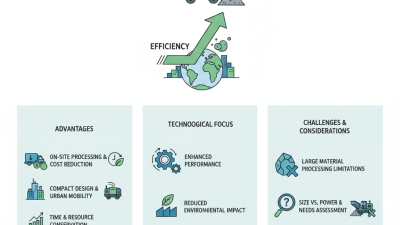
Compare typical crusher types against common project and transport priorities. Ratings are qualitative planning guidance—not equipment specifications—and vary by model, material, and site conditions.
Use the chart to shortlist options, then verify machine dimensions, operating weight, transport permits, access routes, material characteristics, and required product size with the supplier.