How to Choose a Bentonite Crusher in 2026?
Choosing a Bentonite Crusher starts with the material, not the machine brochure. Bentonite can arrive as dry, dusty lumps or damp, sticky clay. Those differences affect feeding, blockage risk, wear, and the product size your process can use. A crusher that performs well on a dry sample may struggle with moist feed. Small details matter.
For this guide, Alex Morgan is an illustrative process-engineering expert, not a verified interview source. His guiding line is: “Match the crusher to the clay’s condition and the product you need—not just the headline capacity.” Treat that as a practical principle, not a documented quotation. Ask suppliers about feed-size limits, moisture tolerance, output range, and how capacity changes under your actual operating conditions. Request a material test when possible. A neat brochure is not a test.
Look closely at the full circuit. Check the feeder, discharge path, screening needs, dust collection, power use, and access for routine maintenance. Sticky material can build up around transfer points. Fine particles may also need effective dust control. Compare jaw, roll, hammer, or other suitable designs against your feed and downstream requirements; no crusher type is best for every bentonite plant. Get clear information about wear parts, cleaning, service response, and expected operating costs. Then verify the claims with representative samples and measurable acceptance criteria. I would still leave room for doubt: ore can vary, and a single trial may not reflect a full production shift. A sensible choice is one you can inspect, test, and maintain.
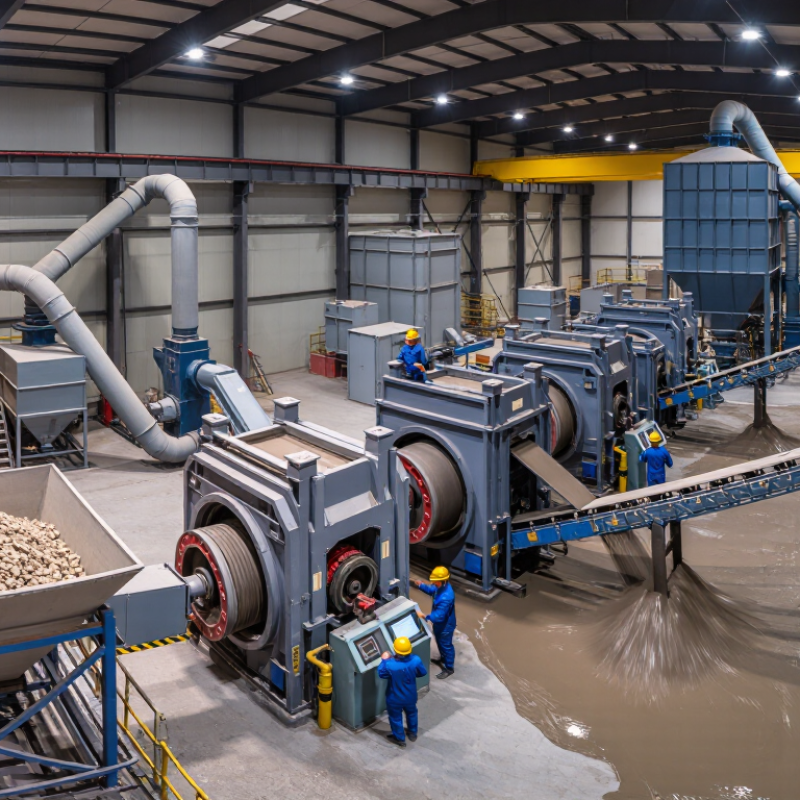
Bentonite is not one uniform feed. Its montmorillonite content, moisture, swelling behavior, and incoming lump size can vary by deposit and application. A dry, friable sample may crush cleanly, while damp clay can smear across liners and block discharge points. Test representative material, including the wettest expected feed. Small samples can mislead.
The U.S. Geological Survey’s Mineral Commodity Summaries 2024 reports U.S. bentonite mine production of about 4.6 million metric tons in 2023. That scale reflects varied markets, from drilling fluids to foundry use; each requires different product sizing and handling. Define the target particle range, hourly throughput, operating hours, and acceptable fines before comparing crusher designs. Check whether the feed contains stones or other hard inclusions, too.
For sticky, moisture-sensitive material, ask suppliers for trials using your own bentonite—not just a clean, dry sample. Record throughput, power draw, blockage frequency, and product-size distribution. A machine that meets a nominal capacity may still struggle with wet feed or uneven lumps. This is where plans wobble. Revisit the moisture assumptions after testing, and leave room for seasonal variation.
How to Choose a Bentonite Crusher in 2026?
Compare Crusher Types for Each Processing Stage
Crusher choice depends on where the machine sits in the process. Freshly mined bentonite may arrive in large, damp lumps, while dried material breaks more easily. The U.S. Geological Survey’s Mineral Commodity Summaries 2025 estimates U.S. bentonite production at about 4.8 million metric tons in 2024. That scale makes steady feed and manageable downtime practical concerns, not minor details.
For primary reduction, a jaw crusher can handle large lumps, but sticky feed may bridge or cling inside the chamber. Check moisture and lump size during real production, not only from a sample. For a more controlled intermediate size, a roll crusher often produces fewer fines and offers a steady nip on dry, moderately hard clay. Keep it practical. Inspect the discharge for buildup.
At the final reduction stage, a hammer mill can suit dry, friable bentonite when finer material is needed. It may create excess fines if the feed is already small or the rotor runs too fast. A neat laboratory feed size can still mislead; wet clay on a rainy shift behaves differently. Compare throughput, product-size distribution, moisture tolerance, and cleaning time across a full shift. Small trials help, but the scale-up still needs careful review.
| Processing Stage | Crusher Type | Typical Feed | Typical Product | Best Fit for Bentonite | Key Limitation | Selection Check |
|---|---|---|---|---|---|---|
| Primary crushing | Jaw crusher | Run-of-mine lumps; commonly tens to several hundred millimetres, depending on the machine and mine feed. | Coarse, reduced-size material for secondary processing; the discharge size is set by the jaw opening and crusher configuration. | Suitable for the first size-reduction stage when the feed is relatively dry and contains large, irregular lumps. | Wet or sticky clay can adhere to surfaces or obstruct the feed and discharge openings. | Check maximum lump size, required capacity, discharge setting, and whether the material will be crushed dry. |
| Secondary crushing | Hammer crusher | Jaw-crushed material, generally smaller than the primary feed; allowable feed size varies by model. | Smaller fragments, with product size influenced by rotor speed, grate openings, and material properties. | Can reduce relatively soft, dry bentonite efficiently when a finer crushed feed is needed before milling. | Moisture and sticky feed can cause build-up or screen blockage; impact can also create excess fines. | Review feed moisture, target particle size, wear-part requirements, and the need for a grate or screen. |
| Controlled intermediate sizing | Roll crusher | Pre-sized lumps or fragments that fit within the roll gap and machine capacity. | Relatively uniform, compressed product; the roll gap helps control the top size. | Useful when a more controlled product size and limited over-crushing are priorities. | Not suitable for oversized feed beyond its design limits; sticky material may coat rolls and reduce performance. | Compare roll gap, feed-size limit, desired product distribution, and cleaning or maintenance access. |
| Fine crushing, where required | Impact crusher | Smaller, pre-crushed material within the selected machine’s feed limit. | Finer crushed material, with particle shape and size distribution dependent on rotor and impact settings. | May be considered for dry feed when additional size reduction is needed before a grinding circuit. | Can generate more fines and wear; moisture-sensitive feed may build up inside the machine. | Confirm the required feed for the next process and compare product distribution, energy use, and wear. |
| Fine powder production | Grinding mill (not a crusher) | Crushed and, where necessary, dried bentonite within the mill’s specified feed-size range. | Powder sized to the application; achievable fineness depends on the mill, material, and operating settings. | Used after crushing when the product must meet a fine-powder specification. | A crusher alone does not produce a controlled fine powder; bentonite moisture and desired fineness affect mill selection. | Specify required particle-size distribution, feed moisture, throughput, and any classification or drying needs. |
| Wet or highly sticky feed | Conditioning and feed-system review before crusher selection | Moist, plastic, or clay-rich material that tends to smear, cake, or bridge. | Depends on the chosen preparation and crushing route; no single crusher guarantees blockage-free operation. | Important when bentonite is mined or handled with high or variable moisture. | Directly applying a fine crusher to sticky feed can lead to coating, plugging, unstable throughput, and frequent cleaning. | Test representative material and assess moisture management, feeder design, access for cleaning, and seasonal variation. |
Note: Feed and product sizes vary with bentonite properties, moisture, crusher design, and operating settings. Treat size descriptions as general selection guidance, not guaranteed specifications; confirm them through supplier data and representative material testing.
How to Choose a Bentonite Crusher in 2026?
Capacity should match the actual feed, not a catalogue’s best-case rating. The U.S. Geological Survey’s Mineral Commodity Summaries 2025 estimated U.S. bentonite production at 4.6 million metric tons in 2024. That scale highlights why steady throughput matters. Ask suppliers to state capacity for your feed moisture, bulk density, and incoming lump size. A crusher handling dry, uniform material may perform differently on damp, sticky clay.
Particle size must fit the next process. Specify a target size range or sieve result, rather than asking for “fine” output. Bentonite can smear or build up inside equipment, so inspect liners and discharge areas during a representative material trial. That matters. Check both average output and the share of oversize particles; one number can hide an uneven product. A trial may also reveal maintenance needs that a spreadsheet misses.
Energy comparisons should use measured kilowatt-hours per tonne at the required product size. The U.S. Department of Energy’s 2007 Mining Industry Energy Bandwidth Study identifies crushing and grinding as important areas for energy-efficiency improvements. Request power data under comparable operating conditions, including feed size and throughput. A low motor rating alone proves little. Track energy, output, and downtime over several shifts; real plant conditions can be messier than expected.
How to Choose a Bentonite Crusher in 2026?
Check Wear Parts, Dust Control, and Maintenance Access
Bentonite can cling to crusher surfaces, especially when feed contains moisture. Ask how the machine handles buildup and whether liners, hammers, or other wear parts can be inspected without dismantling major assemblies. Check their thickness and replacement procedure on a sample unit, if possible. A part that looks sturdy may still be awkward to change. Small details matter.
Request a clear wear-parts list, expected inspection intervals, and realistic replacement lead times. These depend on feed size, moisture, and operating hours, so generic promises are not enough. Look for simple access points and lifting provisions that suit your maintenance crew. Can technicians reach common service areas while following the machine’s isolation procedure? If the answer is unclear, keep asking.
Dust control deserves the same scrutiny. Bentonite fines can escape at feed and discharge points, so inspect enclosure seals, extraction connections, and cleanout access. Ask how operators check filters and remove settled material without spreading dust through the work area. A tidy demonstration is useful, but it may not reflect a busy shift. Request a practical maintenance walkthrough, then compare it with your site layout and cleaning routine. Dust travels. Even a well-designed crusher can disappoint if access is cramped or extraction is poorly matched to the process.
How to Choose a Bentonite Crusher in 2026?
Check supplier support before comparing machine prices. Ask for a written commissioning plan, local spare-parts availability, and realistic response times. Request references from sites processing similar clay, not just hard rock. Bentonite can be sticky, so ask how the proposed feed opening, liners, and discharge design handle wet material. A polished quote can still miss the details.
Safety checks should match the actual feed. The U.S. Geological Survey’s Mineral Commodity Summaries 2024 estimated U.S. bentonite production at about 4.6 million metric tons in 2023. That scale makes reliable dust control and maintenance access practical concerns, though national output is not a sizing rule. If feed testing identifies crystalline silica, OSHA’s respirable-silica standard sets an eight-hour exposure limit of 50 micrograms per cubic meter. Ask for enclosure, extraction, and sampling plans. Check whether workers can clear blockages without reaching into hazardous zones.
Compare total operating cost over several years, not just purchase price. Include electricity, wear parts, labor, planned downtime, and freight for replacement components. Ask the supplier to state expected throughput using your moisture range and target particle size. Then check those assumptions against a sample test. Small gaps matter. A low quote may hide frequent liner changes; an expensive service plan may not fit your site. Revisit the figures after commissioning, because real clay rarely behaves exactly like a spreadsheet.
Compare supplier support, safety provisions, and modeled annual operating cost—not purchase price alone.
How to read this example: The supported option has a higher assumed purchase price but lower modeled downtime, maintenance, and wear-part costs. These are illustrative inputs, not industry averages or supplier quotes.
Model assumptions: five-year straight-line purchase-cost allocation with no residual value; 2,000 operating hours per year; electricity at $0.10/kWh; 45 kW average draw; downtime valued at $200/hour. Energy cost is calculated from power × operating hours × electricity price. Verify actual power draw, wear-part life, service response times, guarding, interlocks, and lockout provisions with each supplier; check applicable local safety requirements.